
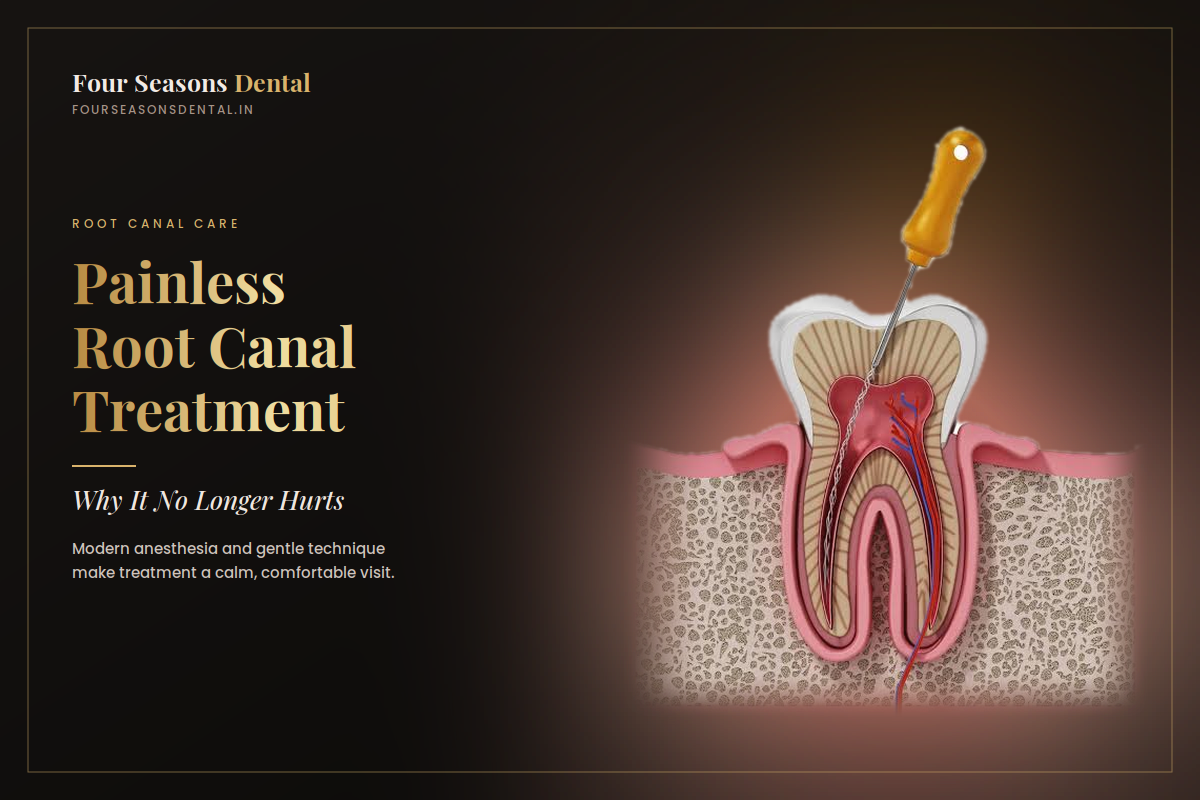
A root canal does not hurt anymore, and that is not a marketing line. Modern anesthesia, rotary instruments, and digital mapping have turned what used to be a dreaded two-hour ordeal into a procedure most patients describe as similar to getting a filling. If you are putting off treatment because of a painful root canal treatment you had years ago, or one your parents described, the experience you are picturing no longer matches what happens in a modern dental chair.
This shift did not happen overnight. It is the result of decades of refinement in numbing techniques, instrument design, and imaging. The result is a painless root canal treatment that protects your natural tooth without the fear that used to come attached to the word “root canal.”

What Makes Root Canal Treatment Painless Today
Three things changed the experience: better anesthesia, better tools, and better diagnostics.
Local anesthesia now works faster and more reliably than it did even ten years ago. Buffered anesthetics reduce the sting of the injection itself, and techniques like the STA (Single Tooth Anesthesia) system deliver numbing with computer-controlled pressure, so there is no sudden rush of fluid that used to cause discomfort. Once the area is numb, you should feel pressure and vibration during the procedure, not pain.
Rotary endodontic files replaced the old hand files that dentists once used to clean out infected pulp tissue. These nickel-titanium rotary instruments move faster, flex around curved canals more naturally, and finish the job in far less time. Less time in the canal means less irritation to the surrounding tissue, which translates directly into a calmer recovery.
Digital X-rays and in some clinics, 3D cone-beam imaging, let your dentist see the exact shape of your root canals before starting. That precision means fewer surprises mid-procedure and a more predictable, controlled treatment from start to finish. Together, these three advances are why a painless root canal treatment is now the standard of care rather than the exception.
Why Root Canals Got Their Painful Reputation
The fear is inherited, not current. Decades ago, root canal treatment was performed with manual steel files, weaker local anesthetics, and little to no imaging guidance. Dentists often worked partly blind, which meant longer appointments and a higher chance of missed canals or incomplete numbing. Patients who went through that version of treatment understandably passed the fear along.
There is an important distinction worth making here. The pain patients associate with root canals is usually caused by the infection itself, not the treatment. A tooth with an abscessed or inflamed nerve already hurts, often badly, before you ever sit in the dental chair. The procedure is what relieves that pain. Blaming the root canal for the toothache is a bit like blaming the ambulance for the accident.
Are Dental Procedures Painful? What Patients Actually Report
Most patients rate root canal treatment as no more uncomfortable than a routine filling. A frequently cited patient survey found that people who had undergone a root canal were six times more likely to describe it as painless compared to people who had never had one and were only guessing. That gap says a lot. The fear is built on assumption, not experience.
So, are dental procedures painful in general? Local anesthesia has advanced across nearly every area of dentistry, from fillings to extractions to root canals. Mild soreness for a day or two after a procedure is common and manageable with over-the-counter pain relief. Sharp pain during the actual treatment is not something you should expect or accept. If you feel it, tell your dentist immediately so they can add more anesthetic before continuing.
What Happens During a Painless Root Canal Visit
Your dentist begins by numbing the tooth and surrounding gum tissue completely, then waits to confirm you feel no sensation before touching the tooth. A small protective sheet called a rubber dam is placed around the tooth to keep it dry and isolated from the rest of your mouth.
Using rotary instruments, the dentist removes the infected or inflamed pulp from inside the tooth’s canals, cleans and shapes the empty space, and disinfects it thoroughly. The canals are then filled with a biocompatible material called gutta-percha to seal out bacteria permanently. Most straightforward cases take sixty to ninety minutes, and many patients find the hardest part is simply keeping their mouth open that long, not any pain.

The Technology Behind a Painless Root Canal Treatment
Beyond anesthesia and rotary files, several newer tools make the experience gentler still. Apex locators use electronic signals to measure canal length precisely, removing guesswork that used to require repeated X-rays mid-procedure. Ultrasonic activation helps disinfecting solutions reach deeper into tiny canal branches that manual rinsing would miss.
Many clinics have also adopted laser dentistry in Surat for certain root canal cases, where a laser assists in sterilizing the canal and can reduce post-treatment sensitivity compared to traditional methods alone. These tools do not replace good clinical skill, but they remove much of the uncertainty that once made root canal treatment feel unpredictable to both patient and dentist.
Root Canal vs Tooth Extraction: Making the Right Choice
When a tooth’s nerve is infected, you generally have two options: save it with root canal treatment or remove it entirely. Saving your natural tooth is almost always the better long-term choice. An extracted tooth needs to be replaced with an implant or bridge to prevent shifting of neighboring teeth, which costs more and takes longer than completing a root canal treatment in Surat and restoring the tooth with a crown.
Natural teeth also preserve normal chewing force and jawbone density in a way replacements can only approximate. If the tooth structure after treatment is weakened, your dentist may recommend dental crowns and bridges in Surat to protect it from fracturing under everyday biting pressure. That combination, a painless root canal treatment followed by a well-fitted crown, gives most teeth a lifespan of decades.
Recovery After a Painless Root Canal Treatment
Expect mild tenderness around the treated tooth for one to three days, especially when chewing directly on it. This is normal healing, not a sign that something went wrong. Over-the-counter ibuprofen usually manages it well. Avoid chewing hard foods on that side until your permanent crown or filling is placed, since the tooth is more vulnerable to cracking in the interim.
Most patients return to normal activities, including work, the same day. If pain increases after the third day instead of fading, or you notice swelling, that warrants a call to your dentist rather than waiting it out.
Frequently Asked Questions
How long does numbness last after a root canal appointment?
Numbness typically lasts two to four hours after the appointment, depending on the type and amount of anesthetic used. Avoid eating until sensation fully returns to prevent accidentally biting your cheek or tongue.
Can I drive myself home after the procedure?
Yes. Root canal treatment uses local anesthesia only, not sedation, so you remain fully alert and are safe to drive yourself home immediately afterward.
Will I need more than one appointment?
Many root canals are completed in a single visit of sixty to ninety minutes. More complex cases, such as teeth with severe infection or unusually curved canals, may require a second appointment to fully resolve the infection before the final seal is placed.
Does the tooth feel different permanently after treatment?
A treated tooth loses its nerve sensation to temperature but still registers pressure and biting force normally through the surrounding ligament. Most patients report no noticeable difference in day-to-day use once the crown is in place.
What happens if I ignore a root canal recommendation?
Left untreated, the infection can spread to the jawbone, form a painful abscess, or require the tooth to be extracted entirely. Delaying treatment almost always leads to a more involved and expensive problem later.