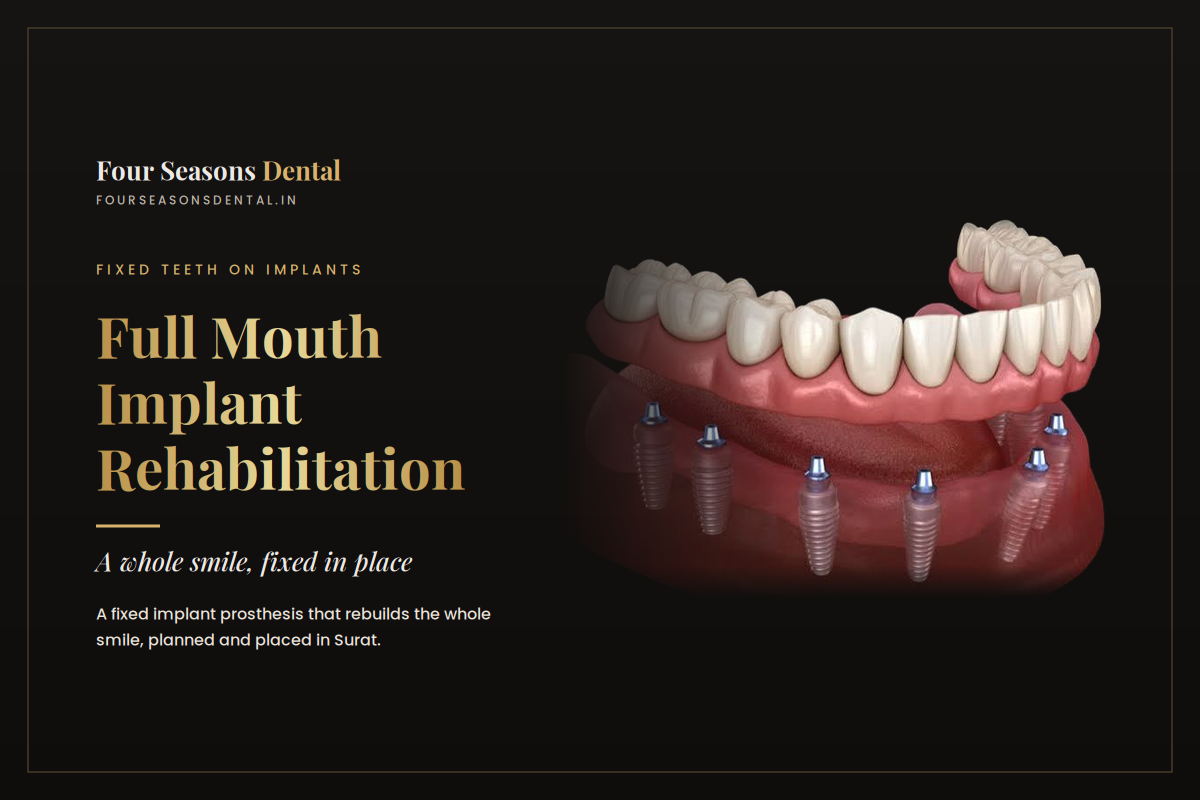
Full mouth implant rehabilitation replaces every missing or failing tooth with fixed teeth anchored to dental implants in the jawbone. The result stays in place around the clock, needs no adhesive and handles a proper meal. Most cases use 4 to 6 implants per jaw to carry a custom-made bridge, which clinicians call a full mouth implant prosthesis.
People usually arrive here after years of patchwork. A crown that failed, a molar that went, a denture that clicks when they laugh. This guide covers who benefits, which prosthesis types exist, how the treatment unfolds and where the honest limits sit.
What Is Full Mouth Implant Rehabilitation?
Full mouth implant rehabilitation is a planned, whole-mouth reconstruction. Implants take over the job of the missing tooth roots, and a fixed prosthesis takes over the job of the crowns. The word “rehabilitation” matters. The aim is to restore chewing power, jaw position, speech and the support your lower face needs, not just to fill gaps.
A single implant treats a single gap. This treatment looks at the whole system at once: bone, gums, bite height, jaw joints and the shape of your smile. For some patients that means one arch. For others it means both. The planning resembles what happens in comprehensive full mouth rehabilitation in Surat, where several problems are sequenced so that fixing one does not undo another.
Who Needs a Full Mouth Implant Prosthesis?
You are a likely candidate if most of your teeth are missing, loose or beyond saving. Common situations include advanced gum disease with mobile teeth, a lower denture that floats whenever you eat, and an upper jaw where decay has outpaced every repair.
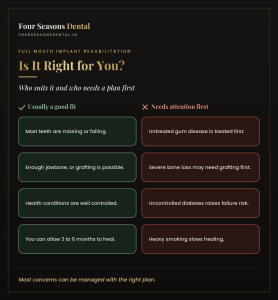
Candidacy depends on bone, gums and general health. Bone is assessed with a 3D CBCT scan, because an implant generally wants around 10 mm of height and 6 mm of width to sit securely, although grafting or angled placement can make up for less. Gum disease must be controlled first, since implants placed into infected tissue fail early. Smoking and poorly controlled diabetes raise the risk noticeably, so we ask patients to stabilise their blood sugar and cut back or quit before surgery. Age alone is rarely the barrier. Healing follows health, not the birth certificate.
Waiting has a cost. Once a tooth is lost, the bone that held it begins to shrink, and up to a quarter of its width can disappear in the first year. That shrinkage is why long-term denture wearers feel their dentures loosen with every passing year.
Types of Full Mouth Implant Prosthesis
Not every prosthesis is built the same way. The material you choose changes how it looks, how it ages and what it costs.
Zirconia Fixed Bridge
Milled from a solid block of zirconia, this is the most durable option. It resists staining and chipping better than acrylic, and its glazed surface lets less plaque cling. The trade-offs are price and a slightly firmer feel when you bite. Well designed and well maintained, it can last well beyond a decade.
Acrylic Hybrid Prosthesis
Acrylic teeth bonded to a titanium frame make a lighter, more forgiving bridge. Many clinics use it as the temporary set worn during healing. Some patients keep it long term. Acrylic wears faster than zirconia and usually needs refurbishing every few years.
Implant-Supported Overdenture
Strictly speaking, this one is not fixed. The denture clips onto 2 to 4 implants and you take it out to clean it. It is the most affordable route and a real upgrade over a conventional denture. If your goal is fixed teeth on implants, though, treat it as a stepping stone rather than the destination.
How Full Mouth Implant Rehabilitation Is Done
The sequence below is typical. Timing shifts with bone quality and with whether extractions or grafting are needed.
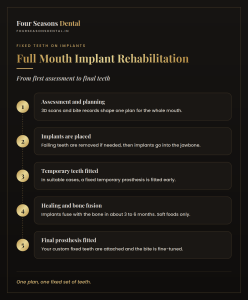
Assessment and Digital Planning
The first visit includes a clinical exam, a CBCT scan and a digital impression of your teeth. Implant positions are mapped on screen before anything touches the jaw, so we know where the bone is strongest and where the final teeth must sit. You leave with a written plan, a timeline and a cost estimate.
Preparing the Mouth
Teeth that cannot be saved are removed and gum disease is treated. Where bone is thin, a graft or sinus lift rebuilds it. Some patients receive implants in the same visit as their extractions. Others wait 3 to 4 months for the sockets to heal.
Implant Placement
Placement is done under local anaesthesia, often with sedation for comfort. One arch typically takes two to three hours. The surgical protocol is the same one used for routine dental implants in Surat, except that several are placed in a single sitting. When the implants are stable enough to share the load, many patients leave with a fixed temporary prosthesis the same day.
Healing and Integration
Over 3 to 6 months, bone grows onto the implant surface in a process called osseointegration. You stay on a soft diet at first and return for reviews so we can check stability and gum health.
Fitting the Final Prosthesis
After integration, fresh scans guide the final design. A try-in lets you judge the shape, shade and bite before the permanent bridge is screwed in. Expect a few short visits in the following weeks for fine adjustments.
Full Mouth Implant Rehabilitation Myths, Busted
Search results on this treatment are full of bold promises. Some are true. Several are not.
“Implant Teeth Are Permanent and Need No Care”
The implants can last decades, but they are not immune to disease. Bacteria can inflame the gum and bone around an implant, a condition called peri-implantitis. Screws loosen and prosthetic parts wear. A full mouth implant prosthesis is fixed, not indestructible.
“You Walk Out With Your Final Teeth the Same Day”
Same-day teeth are real, but they are a provisional set designed to protect the healing implants. The final prosthesis comes after the bone has integrated. Any clinic promising finished permanent teeth on day one is skipping a biological step.
“They Feel Exactly Like Natural Teeth”
Close, but not identical. A natural tooth sits in a ligament that senses pressure. An implant sits directly in bone, so you feel less of the fine feedback. Most people adapt within weeks and stop noticing.
Recovery and Long-Term Care After Full Mouth Implant Rehabilitation
Swelling usually peaks around the second or third day and settles within a week or so. Many patients return to desk work within a few days. Eating stays gentle for the first several weeks while the implants anchor in.
What Home Care Can and Cannot Do
Home care can keep the tissue around your implants healthy. Brushing twice a day, a water flosser and small interdental brushes under the bridge handle the daily plaque. What home care cannot do is remove hardened calculus from beneath the prosthesis or reverse bone loss once it has started. That is the job of a professional review, and regular teeth cleaning in Surat every 3 to 6 months keeps small problems small. We also check bite and screw tightness at these visits.
Cost of Full Mouth Implant Rehabilitation: What Moves the Number
No honest clinic can quote a firm price without scanning your mouth first. The number moves with how many implants each jaw needs and which implant system is used. Prosthesis material matters too, with zirconia costing more than acrylic. Grafting, sedation and any extractions add to the total. Two patients with the same missing teeth can still need very different plans, which is why we put the estimate in writing after the CBCT scan.
Book Your Consultation
If you are weighing full mouth implant rehabilitation, the best first step is a scan and a conversation rather than a guess. Book a consultation at Four Seasons Dental in Surat, and Dr. Jay Patel will walk you through your bone health, your options and a written plan before any decision is made.