
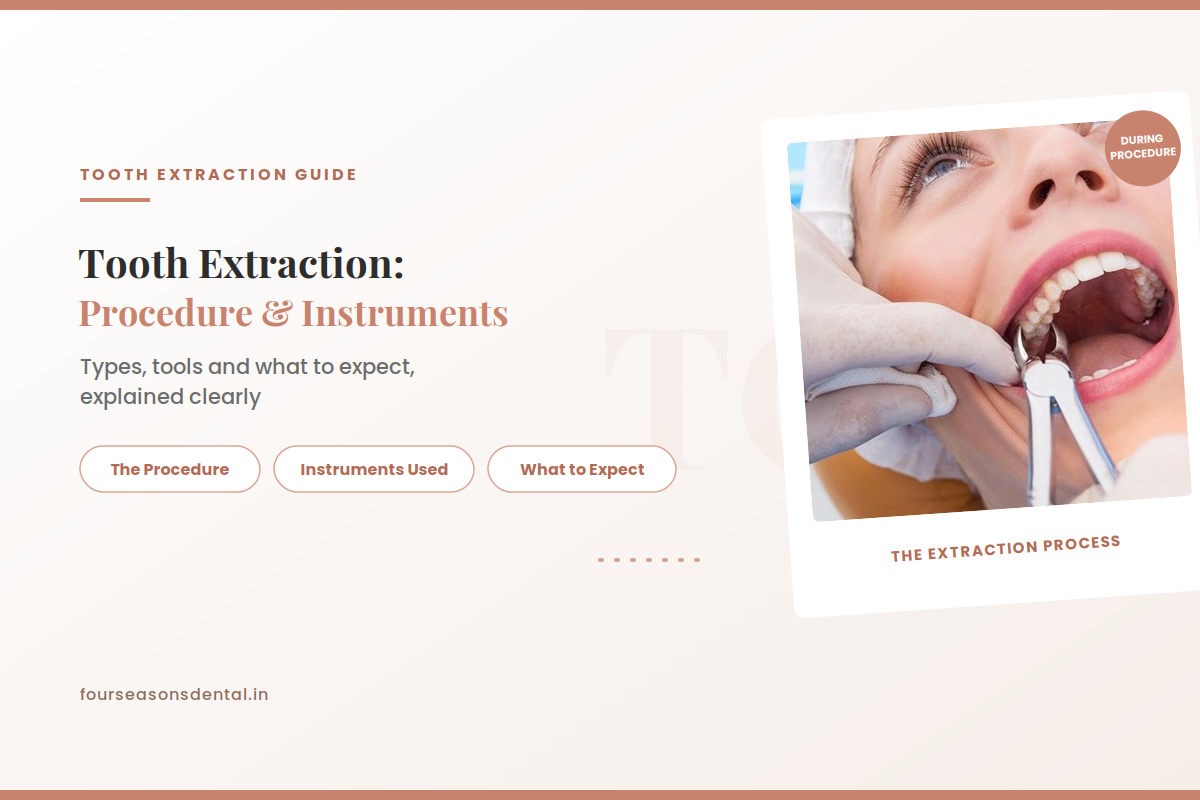
A tooth extraction procedure is the removal of a tooth from its socket in the jawbone, done either with a simple pull under local anaesthesia or through a small surgical cut when the tooth is broken, impacted, or hasn’t fully erupted. Most patients are in and out of the chair in fifteen to forty minutes. The part that worries people isn’t usually the tooth extraction procedure itself; it’s not knowing what the instruments do or why one extraction takes ten minutes while another needs stitches.
We’ve pulled several thousand teeth at Four Seasons Dental, ranging from a single loose molar to fully bony impacted wisdom teeth. This guide walks through what actually happens, so the chair feels less unfamiliar when you’re in it.
What Is Tooth Extraction?
Tooth extraction is the deliberate removal of a tooth when it can no longer be saved, or when leaving it in place would cause more harm than taking it out. Dentists don’t reach for extraction first. A tooth with a deep cavity often goes through root canal treatment instead, and a cracked crown can sometimes be rebuilt. Extraction becomes the answer when decay has destroyed too much of the tooth structure, when an infection has spread past what antibiotics and cleaning can manage, or when a tooth is blocking others from erupting correctly.
The tooth extraction procedure is one of the oldest and most common in dentistry, but “common” doesn’t mean casual. Every extraction is planned around an X-ray, a health history check, and a decision about whether the tooth will come out whole or needs to be sectioned.
When Is a Tooth Extraction Procedure Necessary?
A few situations bring patients to us for a tooth extraction procedure. Severe decay that has eaten past the point a filling or crown can fix is the most frequent one. Advanced gum disease that has loosened a tooth in its socket is another; once the bone support is gone, the tooth often can’t be saved even with deep cleaning. Orthodontic crowding sometimes calls for planned extractions to make room for braces or aligners to work properly. A fractured tooth below the gumline, especially after trauma, may also need removal if there isn’t enough structure left for a crown to rebuild on — our dental crowns and bridges in Surat page covers how that rebuild option works when enough of the tooth remains to save.
Impacted wisdom teeth deserve their own mention here, and we’ll come back to them in detail further down, because they follow a different path than a straightforward extraction.
Types of Tooth Extraction: Simple vs Surgical
Not every tooth extraction procedure looks the same, and the split comes down to how visible and mobile the tooth is.
Simple Extraction
A simple extraction is used on a tooth that’s fully erupted and visible above the gumline. After numbing the area, the dentist loosens the tooth with an elevator and lifts it out with forceps. No cuts, no stitches, no drilling. Most single-rooted front teeth and many back teeth fall into this category, and the whole thing is often done in under fifteen minutes.
Surgical Tooth Extraction
Surgical tooth extraction is a different animal. It’s needed when a tooth hasn’t fully erupted, has broken off at the gumline, or has curved or fused roots that won’t release with simple elevation. Tooth extraction surgery involves a small incision in the gum, sometimes removal of a bit of surrounding bone, and occasionally sectioning the tooth into pieces so each part can be lifted out separately. Stitches usually follow. This sounds more intimidating than it feels; the area is fully numb throughout, and sedation options are available for patients who’d rather not be aware of the process at all.
Tooth Extraction Instruments Used at Four Seasons Dental
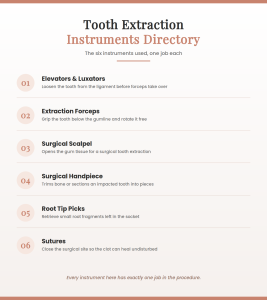
Every tooth extraction procedure relies on a specific set of tools, each doing one job well.
Elevators and Luxators
These are thin, wedge-shaped instruments used first. The dentist works the tip between the tooth and the bone, rocking gently to widen the ligament space and break the tooth free from its socket before forceps ever touch it. A luxator has a sharper edge and cuts through the ligament fibres with less rocking motion, which reduces stress on the surrounding bone.
Extraction Forceps
Forceps are shaped to match the tooth they’re designed for; upper molar forceps look nothing like lower incisor forceps. Once the tooth is loosened, forceps grip it below the gumline and guide it out with a controlled rotating or rocking motion, never a straight yank.
Surgical Instruments for Impacted or Broken Teeth
When a case calls for surgical tooth extraction, additional tooth extraction instruments come into play: a scalpel for the gum incision, a surgical handpiece for bone removal or sectioning, root tip picks for retrieving fragments, and sutures to close the site afterward. Bone files smooth any sharp edges left in the socket before stitching.
What Happens During the Tooth Extraction Procedure
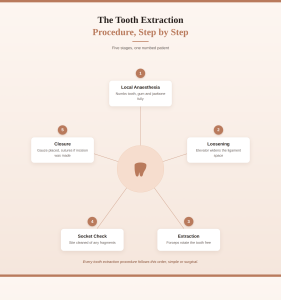
The tooth extraction procedure begins with anaesthesia. A local injection numbs the tooth, gum, and jawbone in that area completely, and patients typically feel pressure during the extraction but not sharp pain. For anxious patients or multi-tooth surgical cases, we offer sedation on top of the local anaesthetic.
Once numb, the dentist checks mobility and decides whether the tooth will lift out simply or needs a surgical approach. An elevator loosens the periodontal ligament first. Forceps then take over, applying gentle rotational pressure until the tooth releases from the socket. For a surgical tooth extraction, the gum is opened, bone is trimmed only if necessary, and the tooth may be split into sections for easier removal.
After the tooth is out, the socket gets a thorough check for any leftover fragments or infected tissue. Gauze is packed over the site to control bleeding, and stitches go in if an incision was made. Most patients bite down on gauze for thirty to forty-five minutes and head home the same day.
Impacted Tooth Extraction: Why Wisdom Teeth Need Extra Care
Impacted tooth extraction refers to removing a tooth that hasn’t erupted through the gum the way it should, most often a wisdom tooth angled sideways or trapped under bone. An X-ray or 3D scan maps exactly how the tooth sits relative to nerves and neighbouring roots before anything else happens.
Because an impacted tooth is partially or fully buried, this is almost always a surgical tooth extraction. The gum is opened, a portion of covering bone may be removed, and the tooth is frequently sectioned into two or three pieces so each part clears the socket without forcing pressure on the jaw. Impacted lower wisdom teeth sit close to a major nerve, which is why we lean on detailed imaging rather than guesswork. Recovery from an impacted extraction generally takes a few days longer than a simple one, with more swelling in the first 48 hours.
If a wisdom tooth or any other tooth has already caused nerve involvement or an abscess, we sometimes coordinate this with our root canal treatment team first to see if the tooth next to it can still be saved before deciding the extraction is the only path forward — you can read more about that option on our root canal treatment in Surat page.
Recovery After a Tooth Extraction Procedure
Healing after a tooth extraction procedure follows a fairly predictable pattern. A blood clot forms in the socket within the first hour, and protecting that clot is the single most important thing you can do in the first 24 hours; no straws, no spitting, no smoking. Swelling peaks around day two and starts easing by day three or four. Most people are comfortable eating soft foods again within 48 hours and back to a normal diet within a week for a simple extraction, or closer to ten days for a surgical one.
Stitches, when placed, are usually dissolvable and disappear on their own within one to two weeks. Full bone healing in the socket takes several months, which matters if you’re planning to fill the gap afterward. For patients who lose a tooth permanently rather than for orthodontic reasons, we usually talk through replacement options at the follow-up visit, and dental implants in Surat come up often since they preserve jawbone density in a way a gap left untreated doesn’t.
Myth vs Fact: Common Tooth Extraction Misconceptions
A few things patients believe about tooth extraction aren’t accurate, and clearing them up matters for how people care for themselves afterward.
Myth: Extraction always means dry socket. Dry socket happens in roughly 2 to 5 percent of extractions, higher for lower wisdom teeth and smokers. It isn’t the default outcome; it’s a complication tied mostly to disturbing the clot too early.
Myth: You need antibiotics for every extraction. Antibiotics are prescribed when there’s active infection or a compromised immune system, not as a routine add-on to every tooth extraction procedure. Overusing them doesn’t speed healing and adds unnecessary risk.
Myth: A missing tooth doesn’t need replacing if it’s not visible. Even back teeth matter. Leaving a gap lets neighbouring teeth drift, changes your bite, and slowly reduces bone in the jaw where the tooth used to sit.
Myth: Extraction is always more painful than keeping the tooth. A badly infected or fractured tooth is often causing more pain before extraction than the healing process afterward. Numbing during the procedure is thorough, and post-extraction discomfort is usually manageable with over-the-counter pain relief within a couple of days.
Ready to Book Your Consultation?
If you’re dealing with a painful or damaged tooth and want a clear answer on what it needs, book a consultation with our team. We’ll walk you through whether extraction is the right call, what type applies to your case, and what your replacement options look like afterward.