
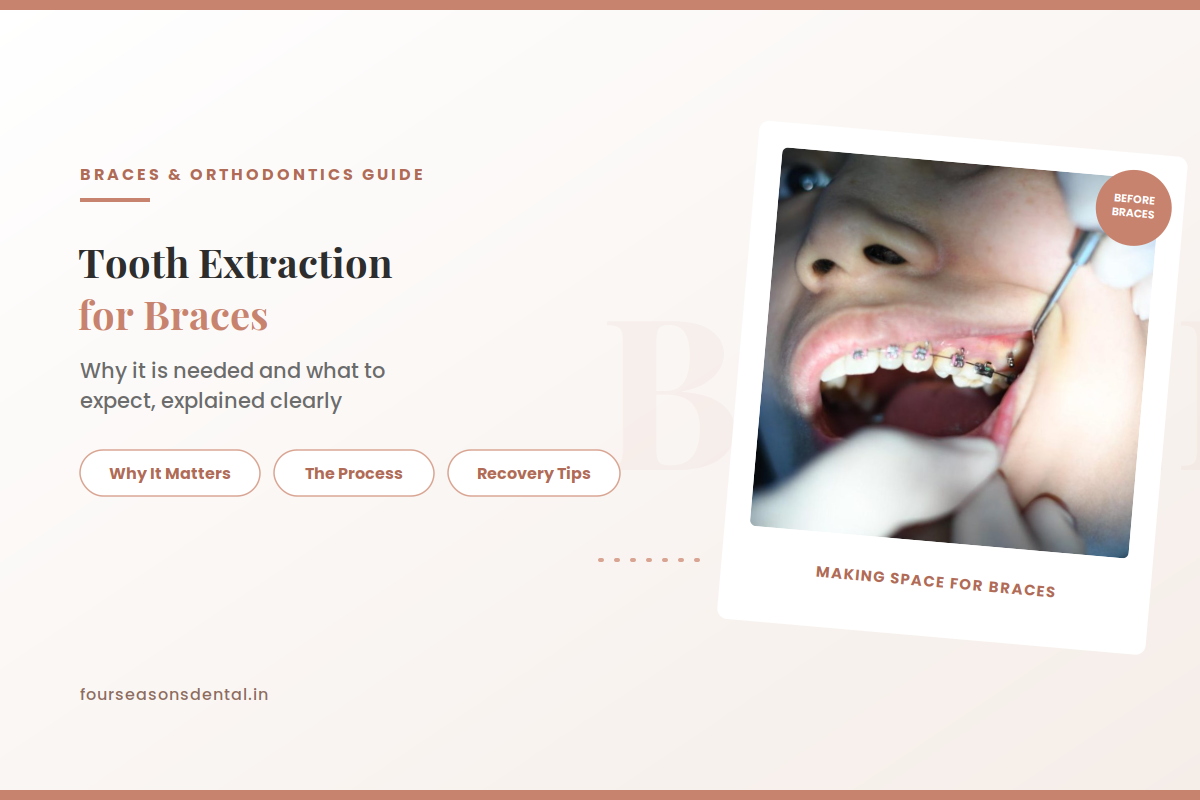
Tooth extraction for braces is usually recommended when there isn’t enough room in the jaw for all the teeth to line up properly, or when a tooth is too damaged, impacted, or misplaced to shift into a healthy position on its own. It isn’t the default plan for every patient. Most orthodontic cases move forward without pulling a single tooth. But when crowding is severe or a jaw is noticeably smaller than the teeth it needs to hold, removing one or two teeth can be the difference between a comfortable, stable bite and years of relapse after the braces come off.
Why Tooth Extraction for Braces Is Sometimes Necessary
Think of a jaw like a parking lot. If you’ve got twelve car spaces and fourteen cars trying to fit, something has to give. Teeth work the same way. When the jaw arch is too narrow to hold every tooth in proper alignment, braces alone can only shift things around so much before they start pushing teeth forward, tilting roots, or bulging the lips outward to compensate.
Orthodontists look at a combination of factors before recommending extraction: the amount of crowding measured in millimetres, the width and length of the dental arches, the angle of the front teeth, and how the upper and lower jaws relate to each other. A mild case with two or three millimetres of crowding might be resolved with expansion or gentle spacing. Severe crowding of seven millimetres or more per arch often can’t be corrected without removing teeth, because there simply isn’t anywhere else for that extra length to go.
Age plays a role too. A child’s jaw is still growing, so crowding that looks severe at eight or nine can sometimes ease up on its own as the arch widens naturally. That’s part of why a pediatric dentist in surat keeps an eye on spacing well before orthodontic treatment even begins, since early guidance can occasionally prevent the need for extraction later on. Once jaw growth slows down in the teenage years, though, a genuine size mismatch is far less likely to resolve without help.
Impacted or supernumerary teeth are another common reason. A wisdom tooth pressing against a molar, or an extra tooth growing where it shouldn’t, can block the whole arch from settling correctly. In these cases, tooth extraction for braces isn’t about crowding at all. It’s about clearing an obstruction so the rest of the plan can work.
Signs You Might Need Tooth Extraction Before Braces
Patients often ask how they’d know in advance. A few patterns tend to show up during the orthodontic evaluation. Teeth that overlap significantly, especially in the lower front, point to a lack of arch space. A severe overbite or underbite where the jaws don’t meet correctly can also call for extraction to help reposition the bite rather than just the teeth. Protruding front teeth that make it hard to close the lips without strain are a third common trigger, since pulling teeth back usually needs somewhere for them to retreat into.
None of these signs guarantee extraction on their own. An orthodontist will confirm with X-rays, models of the bite, and sometimes 3D scans before deciding.
Which Teeth Are Usually Removed for Braces?
Premolars, the teeth just behind the canines, are the most commonly extracted for orthodontic purposes. They sit in a useful spot: removing one on each side of the upper and lower arch (often four in total) creates balanced space without disrupting the front teeth that show most when someone smiles. Occasionally a single tooth is removed if the crowding is limited to one area, or a wisdom tooth is taken out separately if it’s interfering with molar alignment.
Front teeth are rarely touched unless one is badly damaged, has failed root canal treatment, or is so out of position that saving it would compromise the whole treatment plan.
Patients weighing braces treatment usually ask this question first, since knowing roughly which teeth might go helps set expectations long before anything is finalised.
The Tooth Extraction Procedure for Braces: What Happens
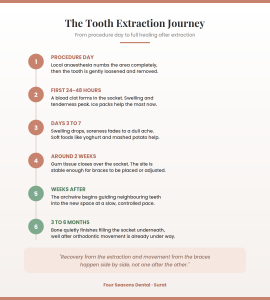
The tooth extraction procedure itself is more straightforward than most patients expect. Local anaesthesia numbs the area completely, so there’s pressure but no pain during the process. For a simple extraction, the dentist loosens the tooth using an instrument called an elevator, then removes it with forceps. The whole thing typically takes under twenty minutes per tooth.
If a tooth is impacted or hasn’t fully erupted, the procedure takes a bit longer and may involve a small incision in the gum to access it, followed by dissolvable or removable stitches. Either way, patients are awake and comfortable throughout, and most drive themselves home afterward unless sedation was used.
At our clinic, we always sequence extractions carefully around the orthodontic timeline. Sometimes the tooth is removed a few weeks before braces go on, giving the gum and bone time to settle. Other times it happens right after the braces are placed, so the archwire can start guiding movement into the fresh space almost immediately.
Tooth Extraction Recovery Timeline
Healing after tooth extraction follows a fairly predictable pattern, though everyone’s pace varies slightly.
The first 24 to 48 hours bring the most swelling and tenderness. A blood clot forms in the socket, and protecting it matters more than anything else at this stage. Ice packs applied in twenty-minute intervals help control swelling, and prescribed pain relief usually keeps discomfort manageable.
Days three to seven are when most of the visible healing happens. Swelling drops noticeably by day three, and soreness fades to a dull ache that responds well to over-the-counter medication. Soft foods like yoghurt, mashed potatoes, and scrambled eggs are easiest during this window.
By two weeks, the gum tissue over the socket has usually closed, though the deeper bone continues remodelling for a few months. This is often around when braces are placed or adjusted, once the site is stable enough to handle a bit of pressure.
Full tooth extraction recovery, meaning complete bone fill of the socket, can take three to six months, but this doesn’t delay orthodontic movement. Braces can safely begin using that space well before the bone has finished healing underneath.
Caring for Your Mouth After Extraction Before Braces Go On
Rinsing gently with warm salt water starting the day after extraction keeps the area clean without disturbing the clot. Smoking, using straws, or spitting forcefully should be avoided for at least three days, since the suction can dislodge the clot and cause a painful condition called dry socket. Brushing can continue everywhere except directly over the extraction site for the first two or three days.
Most patients are back to normal eating within a week. Any sharp pain that appears three or four days after the procedure, especially if it radiates toward the ear, is worth calling the clinic about rather than waiting it out.
Extraction vs Non-Extraction Orthodontics: What’s the Difference
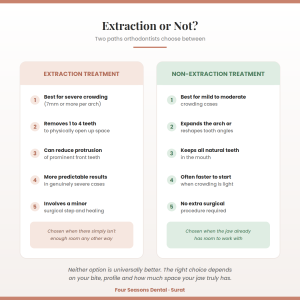
Non-extraction treatment relies on expanding the arch, reshaping tooth angles, or using interproximal reduction (very light filing between teeth) to create space. It works well for mild to moderate crowding and avoids the extra procedure altogether. Extraction treatment, on the other hand, physically removes teeth to open up room, which tends to give more predictable, stable results in severe crowding cases and can reduce facial protrusion where that’s a concern.
Neither approach is universally “better.” A skilled orthodontist in surat will weigh facial profile, bite relationship, and long-term stability before recommending one path over the other, and the reasoning behind that choice varies a lot from case to case.
Adolescents going through growth spurts sometimes have more non-extraction options available simply because their jaws still have room to develop, which is one reason getting an orthodontic opinion earlier rather than later tends to widen the range of choices on the table.
Common Myths About Tooth Extraction for Braces
Myth: Extraction makes your face look sunken. This idea comes from cases decades ago where too many teeth were removed relative to the crowding present. Modern orthodontic diagnosis is far more precise about how many teeth actually need to go, and facial support usually comes from bone structure and lip posture, not the presence of a couple of extra teeth.
Myth: You can skip extraction if you just wear braces longer. Time doesn’t create space. If the jaw is measurably too small for the teeth, prolonging treatment without extraction usually just pushes teeth forward or tips them at unhealthy angles, which raises the risk of relapse.
Myth: Extraction gaps close on their own without braces doing the work. The socket heals, but the space doesn’t shift the neighbouring teeth into it automatically at a useful rate or angle. That controlled movement is exactly what the braces are there to manage.
What Home Care Can and Cannot Do
Good oral hygiene can prevent the kind of decay or gum disease that sometimes forces a tooth to be extracted in the first place. It cannot, however, create jaw space, fix an impacted tooth, or substitute for a professional evaluation once crowding has already set in. Once extraction is genuinely needed, no amount of brushing or flossing changes that recommendation. The role of home care shifts to supporting a smooth recovery afterward.
A Note from Dr. Jay Patel
“Patients are often more anxious about the word ‘extraction’ than the procedure itself deserves. In practice, most people describe it as far less uncomfortable than they braced themselves for, no pun intended. What matters more to me is making sure the decision is right in the first place. I don’t recommend removing a tooth unless the models and X-rays clearly show it’s needed for a stable result. When it is needed, timing it well with the orthodontic plan makes the whole treatment smoother and often shorter overall.”
Ready to Find Out If You Need Extraction Before Braces?
Every bite is different, and the only way to know whether tooth extraction for braces applies to your case is a proper evaluation with photographs, X-rays, and a look at how your teeth currently fit together. If you’re in Surat and weighing your options, book a consultation with our team, or browse more guides like this one on our blog while you decide.
Frequently Asked Questions
Does tooth extraction hurt more than getting braces put on?
No. Extraction is done under local anaesthesia, so the procedure itself is painless, and most patients find the soreness afterward comparable to a bad mouth ulcer rather than acute pain. Getting braces fitted can actually cause more lingering tenderness over the following two to three days as teeth start responding to pressure.
Will I need a gap filler or temporary tooth while braces close the space?
Usually not. Braces are designed to close the extraction gap gradually as part of the overall movement plan, so a temporary prosthetic isn’t typically needed. In rare cases where the gap is large or treatment is paused, a removable spacer might be used briefly.
Can I eat normally the same day as the extraction?
Soft, cool foods are fine within a few hours once numbness wears off. Hot food, hard or crunchy items, and anything requiring heavy chewing on that side should wait two to three days to avoid disturbing the healing socket.
How many teeth are typically removed for braces in one visit?
It depends on the case, but many orthodontists remove all needed extractions in a single appointment when four premolars are involved, to avoid multiple separate recovery periods. Some clinics prefer splitting them across two visits for patient comfort, particularly with younger patients.
Does removing a tooth for braces increase the risk of losing other teeth later?
No, as long as the extraction was properly planned and the remaining teeth are healthy. The space is deliberately created and closed under controlled orthodontic movement, which doesn’t weaken or destabilise the neighbouring teeth.