
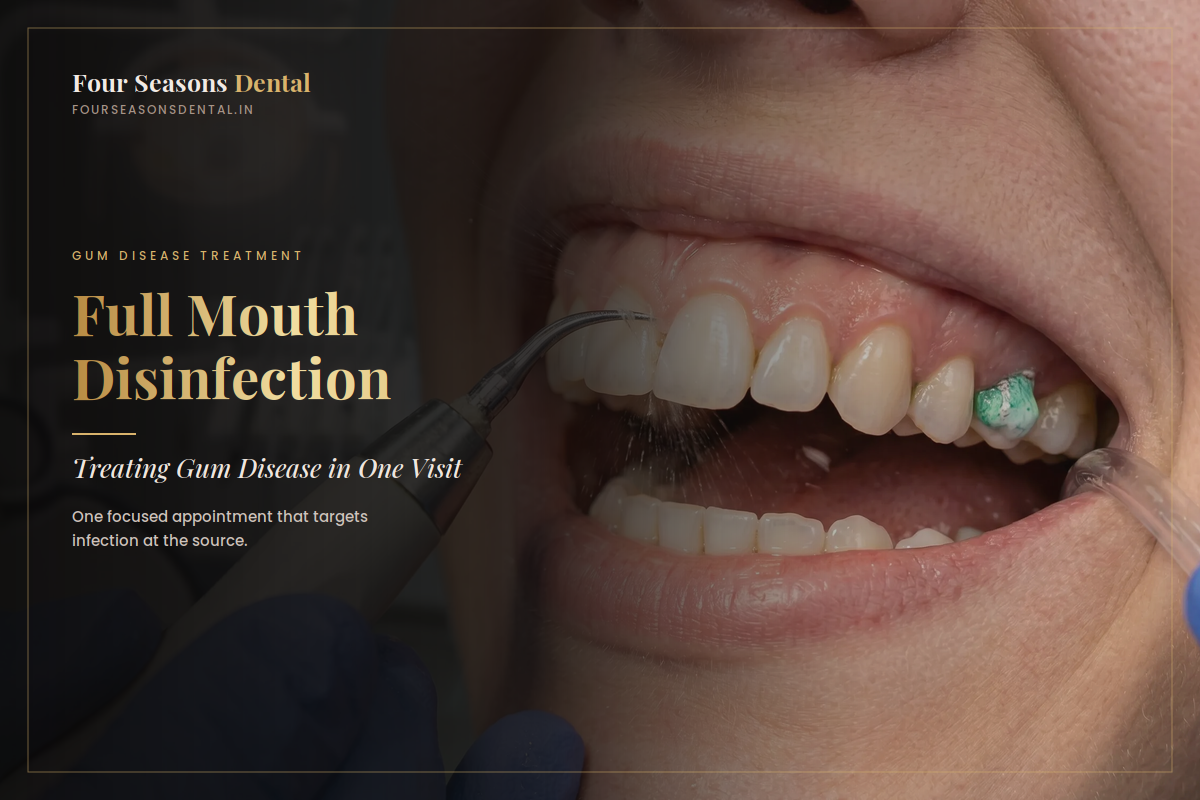
Full mouth disinfection is a gum disease treatment in which a dentist cleans and disinfects every infected pocket in your mouth within 24 hours, usually in one long sitting, rather than over four visits spread across a month. The idea is simple. If bacteria survive in one untreated corner, they move into the freshly cleaned corner within days. Treating everything together removes that chance.
This guide explains how full mouth disinfection works, what the research says about it, who benefits most and what recovery feels like. It also covers what it cannot do, because a single visit, however thorough, has limits that every patient should hear about before sitting in the chair.
What Is Full Mouth Disinfection?
Full mouth disinfection, often shortened to FMD, is a one-stage method of treating periodontitis, the advanced form of gum disease. A research team led by Marc Quirynen at the University of Leuven in Belgium introduced it in 1995. Their concern was practical. In conventional treatment the dentist cleans one quarter of the mouth at a time, with one or two weeks between visits. During that gap, bacteria lurking on the tongue and tonsils, or in untreated pockets, drift back into the area just cleaned.
The full mouth disinfection protocol closes the gap. All four quadrants are scaled and root planed within 24 hours, and an antiseptic is applied to the pockets as well as to the tongue and throat. “One visit” usually means a single sitting of two to three hours under local anaesthesia. When the infection is heavy or the patient tires easily, the work is split into two shorter sittings on consecutive days.
Gum Disease Basics: Why Some Cases Need More Than a Routine Clean
Healthy gums hold the tooth snugly, leaving a shallow groove of 1 to 3 mm around it. When plaque hardens into tartar and stays there, the gum pulls away and the groove deepens into a pocket. Pockets of 4 mm or more start trapping bacteria that a toothbrush cannot reach. At 5 mm and beyond, no amount of home care will clean the bottom.
Gingivitis, the early stage, shows up as red, puffy gums that bleed when you brush. It reverses fully with professional cleaning and better habits. Periodontitis is different. Here the infection has begun dissolving the bone that anchors the teeth, and that loss does not reverse on its own.
The damage is not limited to the mouth. Periodontitis is linked with poorer blood sugar control in people with diabetes, and studies associate it with a higher risk of heart disease, although a direct cause has not been proven. Chronic gum infection keeps the body’s inflammation switched on, which is one more reason to treat it thoroughly instead of putting it off.
A routine scaling session, like the teeth cleaning in Surat that most adults need twice a year, removes plaque and tartar above the gumline and just beneath it. It is not built for deep pockets where hardened calculus has settled on the root surface. Those cases need instruments that reach the root, which is where full mouth disinfection comes in.
Signs You May Need Full Mouth Disinfection
Only your dentist can confirm it with a periodontal chart and X-rays, but these signs raise the question:
- Bleeding during brushing or flossing on most days
- Bad breath or a bad taste that returns within an hour of rinsing
- Gums that appear to be shrinking, so teeth look longer
- Teeth that feel slightly loose or have started to drift
- Pus or tenderness along the gumline
How Full Mouth Disinfection Works: The Protocol Explained
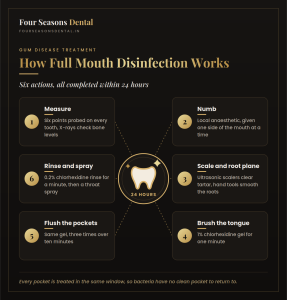
Treatment starts with measurement. Your dentist probes six points around every tooth, records pocket depths and bleeding, and takes X-rays to check bone levels. This baseline matters because it is how both of you will judge the result six weeks later.
Anaesthesia comes next, usually given one side of the mouth at a time so that you are never numb everywhere. Ultrasonic scalers then break up the tartar, and fine hand instruments smooth the root surfaces. This combination is called scaling and root planing. Smooth roots resist new plaque and let the gum reattach more firmly.
The disinfection element is what separates full mouth disinfection from an ordinary deep clean. In the original protocol, the tongue is brushed with 1% chlorhexidine gel for one minute. Each pocket is flushed with the same gel three times over ten minutes. The patient then rinses with 0.2% chlorhexidine for a minute, and the throat is sprayed as well, because tonsils and the back of the tongue harbour the same bacteria that drive gum disease.
Some clinics add a diode laser at the end to reduce bacteria inside each pocket. Laser dentistry in Surat can suit patients who dislike the vibration of scalers, and it may help gums feel calmer afterwards. Research suggests it works as an add-on, though, and never as a replacement for scaling and root planing.
Full Mouth Disinfection vs Quadrant-Wise Treatment: What the Evidence Says
Here the honest answer needs care. Early trials by the Leuven group reported better pocket reduction with full mouth disinfection than with the traditional approach. Later and larger reviews, including a Cochrane review of full-mouth treatment within 24 hours, found the clinical differences to be small. Both methods reduce pocket depth and bleeding well.
So the real advantage is not a magical result. It is convenience and speed. One or two sittings instead of four means fewer days off work and a shorter window where infection can bounce back, with quicker progress into the maintenance phase. For people travelling in from other towns in Gujarat, that alone can decide whether treatment gets finished at all.
Researchers have also asked whether the chlorhexidine is doing the heavy lifting. Trials comparing same-day treatment with and without it suggest the antiseptic adds little. The benefit seems to come from the timing, not the chemical. Some clinics therefore adjust the antiseptic portion to the patient.
Expect measurable change rather than a cure. In many patients, pockets of 5 to 6 mm shrink by about 1 to 2 mm within six to eight weeks, and bleeding on probing falls sharply. A few people run a mild fever or feel tired for a day, as the body reacts to bacteria released during cleaning. It passes quickly.
Who Is a Good Candidate for Full Mouth Disinfection?
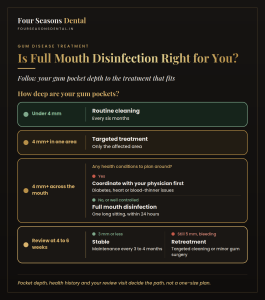
Full mouth disinfection suits adults whose gum disease is spread across the mouth, with several pockets of 4 mm or more in different quadrants. If the problem sits in one corner, treating that area alone is simpler and just as effective.
Some conditions call for planning rather than a straight yes. Diabetes is the biggest one. Gum infection and blood sugar influence each other, and controlled diabetes often improves by a few tenths of a percentage point in HbA1c after periodontal treatment. Uncontrolled diabetes, heart valve conditions that need antibiotic cover and blood-thinning medication all need coordination with your physician first. Pregnancy is not a barrier, though the second trimester is generally the most comfortable time. Smokers heal more slowly, and the difference shows up at the review visit.
Anyone who is very anxious about long appointments can still benefit. The same disinfection principle works across two shorter sittings within a day or two, or with sedation options discussed beforehand.
Myths About Full Mouth Disinfection and Gum Disease
Myth: One Visit Cures Gum Disease for Good
Full mouth disinfection controls the infection. It does not remove your tendency toward gum disease. Periodontitis is managed over a lifetime, much like blood pressure, and bacteria return within a few months if daily cleaning slips.
Myth: Lost Bone Grows Back After Treatment
Bone that has dissolved does not regrow because the infection is gone. Special regenerative surgery can rebuild certain bone defects in selected cases, but ordinary treatment aims to stop further loss. Gums may also shrink as swelling settles, so teeth can look longer and gaps between them more visible.
Myth: Chlorhexidine Mouthwash Can Do This at Home
Chlorhexidine cannot penetrate hardened tartar, and it cannot reach the bottom of a deep pocket. At home, it works as a short-term helper. Used continuously it stains teeth brown and alters taste, which is why dentists prescribe it for about two weeks at most.
What Home Care Can and Cannot Do
Careful brushing twice a day and daily cleaning between teeth keep new plaque from settling after treatment, and a tongue scraper helps too. None of it can remove tartar already welded to the root. If a tooth has lost too much bone to be saved, saying so early is kinder than delaying. Extraction followed by dental implants in Surat can then give a more stable long-term answer, but only after the gum infection is under control, since implants placed in infected gums fail more often.
Recovery After Full Mouth Disinfection: What to Expect
Numbness lasts two to four hours, so wait until it clears before eating, and keep to lukewarm soft food that day. Soreness and sensitivity peak over two to three days and usually respond to paracetamol or the pain relief your dentist suggests. Light bleeding when you brush is normal for the first few days.
From the next day, rinse gently with warm salt water and brush with a soft brush, angling the bristles toward the gumline. Avoid smoking for at least 72 hours, since it slows healing and raises the chance of complications. If chlorhexidine was prescribed, expect some temporary brown staining and a metallic taste, both of which fade after you stop it.
The review visit at four to six weeks is the real test. Your dentist re-measures every pocket. Sites that have closed to 3 mm or less and stopped bleeding are stable. Any pocket still at 5 mm with bleeding gets targeted retreatment, and in some cases minor gum surgery. After that comes maintenance cleaning every three to four months for the first year, then adjusted to your risk. Our dental blog covers daily gum care, including interdental cleaning, in more detail.
Book Your Gum Health Consultation
If your gums bleed, feel tender or have started to pull back, a periodontal check will tell you exactly how deep the problem runs and whether full mouth disinfection is the right plan. Book a consultation with Dr. Jay Patel at Four Seasons Dental, and leave with your measurements and an honest timeline.
Frequently Asked Questions About Full Mouth Disinfection
How long do the results of full mouth disinfection last?
They last as long as plaque stays under control. Bacteria begin recolonising pockets within weeks when cleaning is poor, and a full return to pre-treatment levels can take a few months. Patients who brush well and clean between teeth daily, and who attend three-monthly maintenance visits, often hold their results for many years.
Will full mouth disinfection get rid of bad breath?
If the smell comes from infected pockets and a coated tongue, it improves markedly, often within a week or two. Breath that stays unpleasant despite healthy gums points elsewhere, such as dry mouth or tonsil stones, and needs a separate check-up.
How is full mouth disinfection different from gum surgery?
Full mouth disinfection works through the pocket opening without cutting the gum. Surgery lifts a small flap so the dentist can see and clean roots directly, and sometimes reshape bone. It is reserved for pockets that stay deep and bleed after disinfection has been given time to work.
What if I am nervous about a long dental appointment?
Tell your dentist before treatment starts. Appointments can be divided into two shorter sittings, breaks can be built in, and calming options such as mild sedation can be arranged where appropriate. Most patients find the anaesthetic injection the worst part, and the rest feels like pressure and vibration.
Is full mouth disinfection safe for older adults?
Age alone is not a barrier. What matters is general health and medication, so bring your prescription list. Treatment is often adjusted for people on blood thinners or with heart conditions, and diabetes needs coordination too. Older patients commonly benefit from keeping their own teeth stable for longer.